Overheads (five lectures):
First Lecture
The Earth's Environment - Prospects for the Future
What is Climate?
A region's climate is the average seasonal behavior of a number
of environmental elements: temperature, moisture, winds, nearby
ocean currents, special geographic factors such as mountains.
The problem is to decide how much time is needed to define average
climate conditions?
Decadal Variability
Let us define a region's cliamte as the average behavior over
the last 100 years.
If we look at local climate changes over the last 100 years, we
see that there are decadal intervals with quite different climate.
Examples: Dust Bowl era (Dirty Thirties), ENSO events (EL Nino)
Longer-Term Climate Variability
Little Ice Age (1350-1850 AD)
Middle Ages Climate Optimuum (1000 -1200 AD)
Glacial/Interglacial Ages
0-12,000 years before present (YBP) - last interglacial (Today's
conditions)
12-71,000 YBP - last glacial
Proxy Climate Data Sources
Proxy data are indirect indicators of what climate was like
before the development of direct measuring tools like thermometers.
Fossils are one type of proxy climate data. Fossils tell us that
climate conditions at a location were similar to where the same
organisms live today.
Sediments are s second type of climate proxy.
Stable isotopes are a third type of climate proxy. Isotopes are
the best climate proxy and are able to provide the best quantitative
estimate of past climate conditions.
Second Lecture
The Once and Future Glacial World (12-71 thousand years ago)
Ice
Continental glaciers extended over most of Canada, Alaska,
Greenland, Antarctica, Fennoscandia, and northern Siberia.
Permanent ocean ice packs extended further out into the ocean
around Antarctica than today and as far south as southern Greenland
and Scotland.
Ocean Circulation
There was a stronger thermal gradient between the Equator
and polar latitudes
The major ocean gyres were compressed toward the Equator by ice
packs
There was stronger circulation due to enhanced thermal gradients
and increased atmospheric circulation.
Atmospheric/Ocean Chemistry
There were much lower concentrations of green-house gases
- carbon dioxide and methane.
Excess carbon compounds were stored in the oceans (forming increased
levels of carbonic acid - more carbonate dissolution).
Sea Level
Seas level was about 150 meters lower than today.
The Baltic and North seas were dry or covered by glaciers.
There were almost no continental shelf environments.
What Causes Glacial Ages?
The best answer is that we are still not sure what causes glacial ages. But, we do have two complementary hypotheses that we think ar ethe primary causes: Milankovich cyclicity in the Earth's orbit around the Sun and Plate Tectobnic changes in the positions of continents and shapes of ocean basins.
Milankovich Cycles
The Earth's movement around the Sun varies in a complex cyclic
manner.
Variations in the Earth's orbit cause longetrm variations in amount
and seasonality of incoming solar radiation.
These changes are one key factor in what causes cyclic glacials
and interglacials.
Influence of Plate Tectonics on Global Climate
The Earth's climate engine strongly involves ocean and atmosphere
circulation.
These circulation patterns are influenced by the placement of
the continents.
Times of past glacial activity have always occurred when continents
prevent warm ocean water from reaching polar regions.
Abrupt Climate Change - I
Heinrich Events (North Atlantic Ocean)
Seven largest events occurred during the last glacial
Massive ice berg discharges into the North Atlantic Ocean - last
hundreds of years
Caused collapse of Canadian continental glacier
Stopped formation of NADW
Led to short warm intervals - not known why
Abrupt Climate Change - II
Younger Dryas (about 10,000 years ago)
600 year return to very cold conditions at the end of the last
glacial
onset and terminations of Younger Dryas occurred in just 10-20
years.
Average annual temperatures in Greenland dropped 10 degrees Centigrade
We still don't understand why this happened.
Third Lecture
The Once and Future Greenhouse World (The world of the dinosaurs)
Plate Tectonic Configuration
Pangaea had broken up.
Laurasia was located in the Northern Hemisphere.
Gondwana was located in the Southern Hemisphere.
The two supercontinents were separated by the Tethys Sea.
A huge Pacific Ocean ran from the North Pole to the South Pole.
Cretaceous Climate
The Cretaceous was perhaps the warmest time for the planet
as a whole in the last 300 million years.
Proxy evidence for warm conditions:
Coal deposits at high latitude
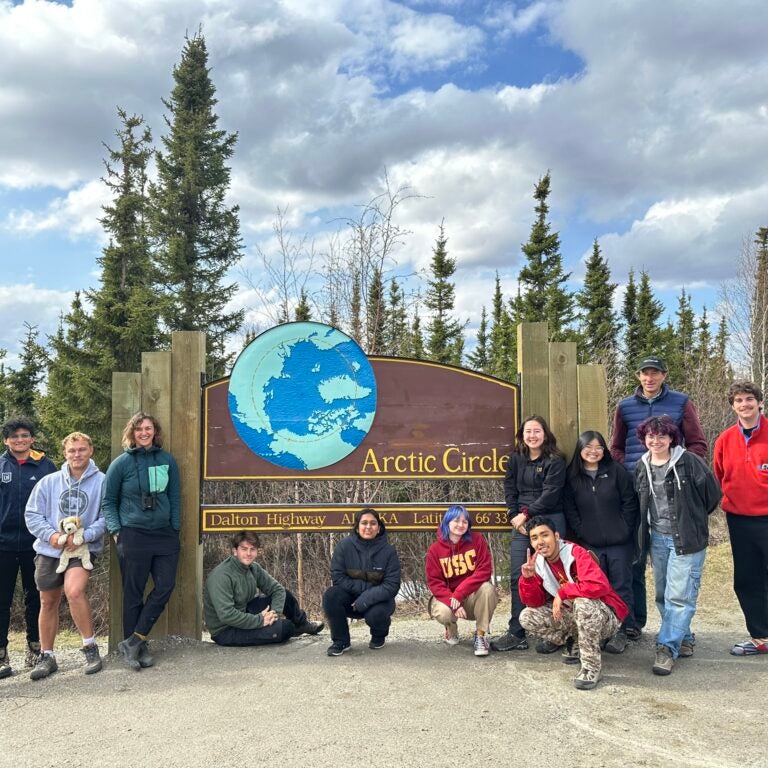
Pollen evidence for trees north of the Arctic Circle
Dinosaur fossils found north of the Arctic Circle
Evaporate deposits throughout the equatorial region
Sea Level
Given a warm climate, it is unlikely that there was any extensive
continental glaciation.
Sea level was perhaps 200-300 meters higher than today.
This caused large areas of the continents to be inundated by broad
shallow seaways.
Central North America from the Rockies to the Appalachians was
an ocean connecting the Gulf of Mexico with Hudson's Bay.
Ocean Circulation
The huge Pacific Ocean permitted ocean gyres to circulate
very near the poles.
The warm climate reduced the thermal gradient so circulation was
sluggish.
The Equatorial Tethy Sea let equatorial currents circle the world.
Continental seaways caused climate in continental interiors to
be milder than today.
Deep oceans were much warmer - less deep ocean circulation.
Atmosphere/Ocean Chemistry
Warmer oceans would have been able to hold less atmospheric
gasses.
Proxy evidence is the atmospheric greenhouse gas concentrations
were 4 to 10 times today!
Ocean bottoms often became anoxic (less deep ocean circulation?).
End Cretaceous Mass Extinction
Almost 40% of marine species died out simultaneously at the
end of the Cretaceous.
All large land and marine animals died out.
This led to dominance of mammals and eventually - humans.
Bolide Impact as cause of the Extinction
Proxy evidence suggests that a huge meteorite impacted at
the time of the end Cretaceous extinctions.
Best guess is that this impact led to a 'nuclear winter' condition
- massive amounts of dust in the atmosphere for several years
killing off most plants.
Fourth Lecture
El Nino/Southern Oscillation (ENSO)
What are normal ocean circulation conditions in the Equatorial
Pacific?
Eastern Boundary currents carry cold water toward the Equator
- this creates upwelling and good fishing conditions.
Equatorial currents carry water westward under the influence of
the Trade winds - water gets warmer.
In the western Pacific warm water pools.
Some of the water continues poleward as western boundary currents.
What is El Nino?
A disruption of the ocean-atmosphere system across the equatorial
Pacific Ocean creating weak Trade Winds.
El Nino was first associated in the 1700s with unusually warm
water in the eastern Pacific Ocean and the disappearance of schooling
fish off the coast of Peru during wintertime in some years.
El Nino was named for the Christ child that was born on Christmas.
What is the Southern Oscillation?
Trade winds blow toward the Equator and help recirculate air
in Hadley Cells.
Hadley Cells are not infinitely long. They occur in cells that
are hundreds of km in east-west size.
At their western and eastern boundaries, they create high and
low pressure centers.
Southern Oscillation is the intermittent east-west shift of Hadley
Cell boundaries.
What Happens During an El Nino?
High and Low pressure centers shift causing Trade Winds to
diminish in strength.
Equatorial countercurrents carrying warm water into the Eastern
Pacific from the Western Pacific are stronger.
Thermocline is lowered in the eastern Pacific and raised in the
Western Pacific.
Upwelling is strongly reduced in the Eastern Pacific.
Consequences of El Nino
Fisheries collapse along California and Peru coasts.
Warm waters in eastern Apcific
Increased rainfall in SW USA and Peru.
Drought in western Pacific/Australia/India
What is La Nina?
The opposite extreme of El Ninos.
Unusually cold water in the eastern Pacific Ocean.
Very strong Trade Wind circulation.
Are there Super ENSO Events?
There is growing evidence that ENSO variability occurs on
several time scales.
Normal ENSO events occur every few years.
Fisheries cycles and rainfall cycles may last for decades.
Are they due to same cliamte factors?
We DO NOT KNOW!
Time Dependence of Fish Populations
Many fish species have long-term life cycles (sardines, tuna, salmon).
We don't know why these cycles exist. Inherent species varibility or longer-term climate change?
FIFTH LECTURE - Global Warming
Possible Causes of Global Warming - 1) Greenhouse effect
Important greenhouse gases (carbon dioxide, methan, water vapor)
Ways to increase greenhouse gases: burning fossil fuels (moslty last 200 years) or deforestation (Mostly last 500 years)
Other natural causes? greenhouse gas variations could not have caused the Roman Cold Period, Midieval Warm Period , and Little Ice Age.
Possible Cause of Global Warmind - 2) changes in solar insolation
We know tha the sun's energy output has bee nreasonably constant for the last billion years or so.
But, we also know that that are some cyclic changes in the sun - 11 year sunspot cycle - that might produce more subtle variations in insolation.
Future Prospects
Climate studies are beginning to give us estimates of what will happen in the next 100 years, but the models do not all agree.
Some future trends? continets wil lwarm more than oceans, high latitudes will warm more than low latitudes, some areas will be wetter while others are drier.